
The AI PPC Management Tool for Agencies That Actually Understands Every Account
The baseline — live account connections, keyword-level analysis, bid recommendations — is table stakes. The question that separates useful from hype: does it build persistent memory for each account individually, or does every session start from zero?
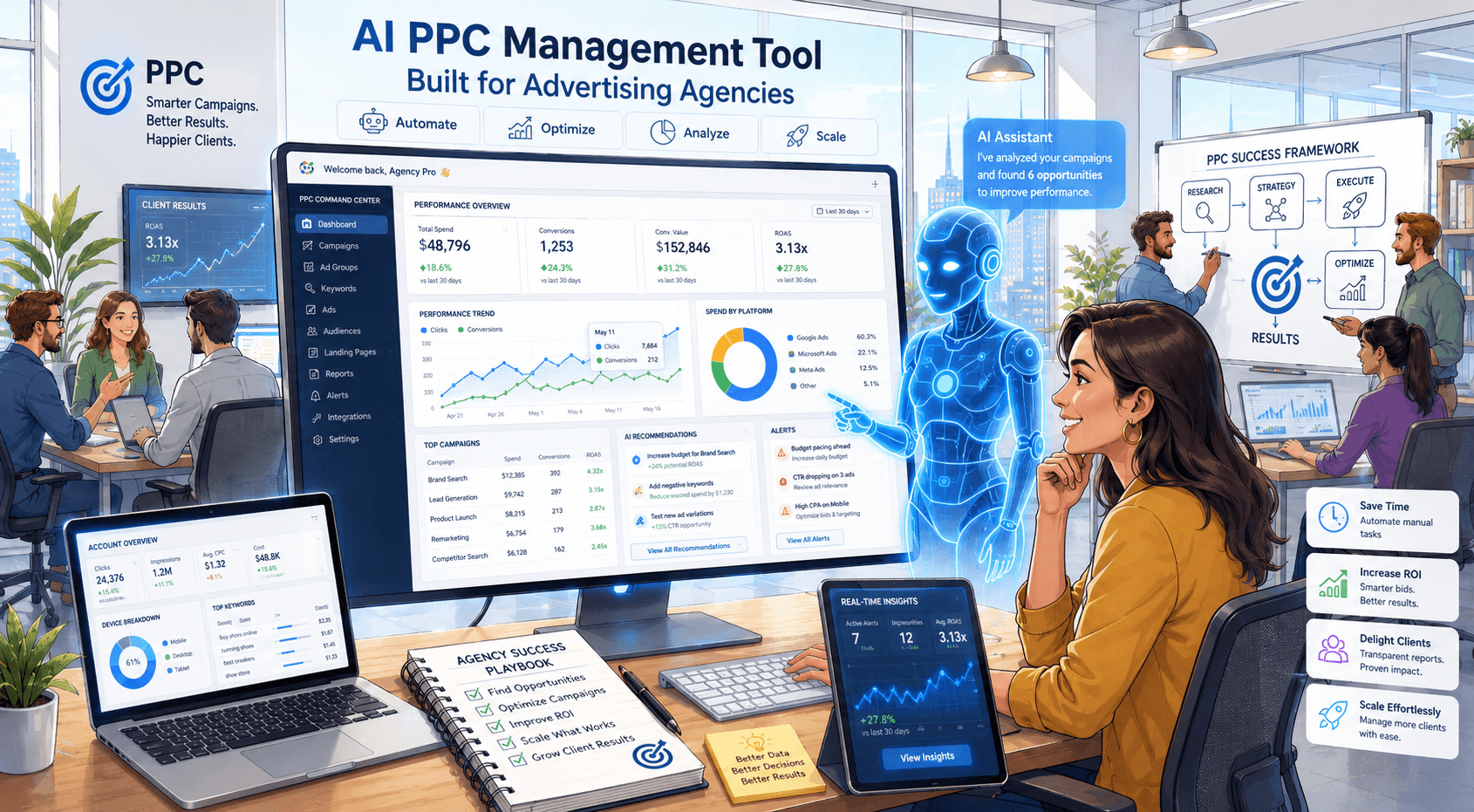
The question that cuts through the category
Most AI PPC tools are capable in a demo and amnesiac in production. They answer fluently when you brief them, then forget everything the next session. You re-explain your deal size, your branded campaign intent, your loss-leader SKUs — every time, from scratch.
If the tool knows exactly as much about your account on Day 30 as it did on Day 1, you're paying for a faster spreadsheet. The compounding value of context is where the actual ROI lives.
What this means at agency scale
At one account, re-explaining context every session is annoying. At fifteen accounts — across different clients, industries, margin structures, and attribution setups — it's a structural inefficiency that consumes the time you were supposed to save.
ROAS Radar maintains a separate persistent memory for each account — not a shared context across your portfolio, but individual institutional knowledge scoped to each client. The $140 CPL that converts at 22% to a $4,200 deal lives in that client's memory. Another client's branded campaigns flagged as defensive positioning, not growth levers, lives in theirs. Each account's constraints, economics, and history accumulate independently, in parallel.
You tell it once, per account. It carries that forward indefinitely — so you're not rebuilding context after every login, every reporting cycle, or every time a new team member touches the account.
What happens when accounts change hands
Institutional knowledge is the first casualty when an account moves — from in-house to agency, manager to manager, team to team. The data transfers. The context doesn't. The incoming manager spends weeks rediscovering what the last person already knew.
With ROAS Radar, the agent's memory persists through the transition. Business rules, historical constraints, account-specific context — they survive the handoff. The new manager inherits an agent that already knows the account.
What it doesn't do
It's read-only. Every recommendation comes to you for review — it does not push changes to your accounts automatically. If you need rule-based automation or autonomous bid management, that's a different category. ROAS Radar is the analytical layer: the part that makes human decisions faster and better-informed.