
PPC Campaign Analysis Software That Tells You Why, Not Just What
Most analytics tools show you that something happened. The expensive part — figuring out why and what to do — still falls on you. That gap has a dollar figure attached to it.
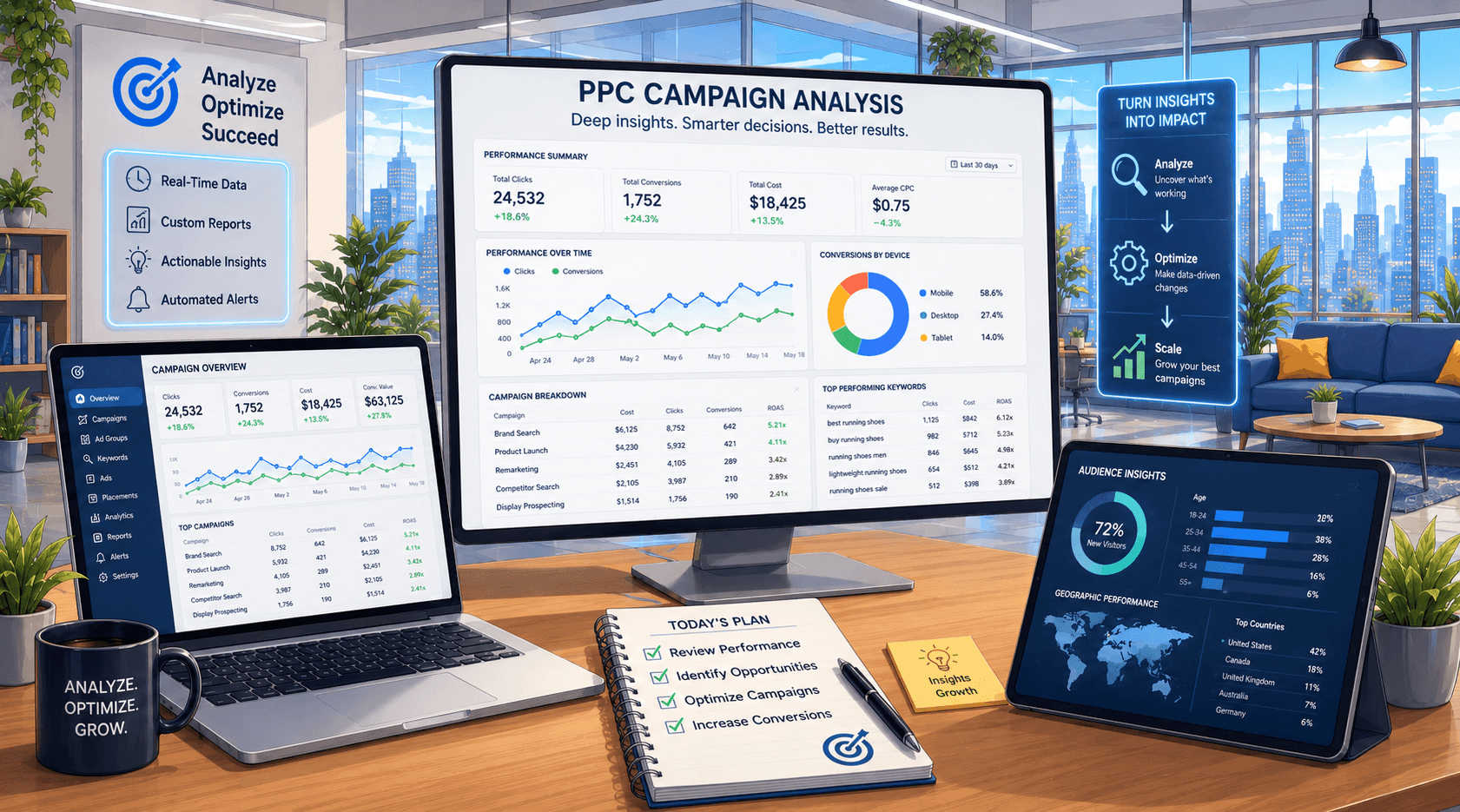
The gap between data and decision has a dollar figure
It's Friday at 4pm. ROAS dropped sharply in the last 48 hours. You log in, pull reports, start cross-referencing. By the time you've diagnosed it — or decided it's not urgent enough to chase down on a Friday — the weekend has started.
Come Monday, you've burned roughly $1,000 at a $500/day spend rate without knowing what caused the drop. Maybe nothing was wrong. Maybe something was. That delay isn't carelessness. It's just what analysis takes when you're doing it manually. The question is what that delay costs across a year.
Dashboards are not analysis
Most PPC analytics tools are dashboards with a sophisticated paint job. They show you that something happened. They do not tell you why, what it means, or what to do.
When you're stretched across multiple accounts, you don't always have time to chase down every anomaly with the rigor it deserves. So you triage. Sometimes that's fine. Sometimes it costs you.
Why the reasoning matters as much as the recommendation
There's a difference between a tool that tells you “pause keyword X” and a tool that tells you “keyword X has driven $4,800 in spend over 90 days with zero attributed conversions, while similar intent keywords in the same ad group are converting at $68 CPA — the spend concentration here is structural, not a bid issue.”
The second recommendation is auditable. You can take it to a client, a manager, or your own judgment and evaluate it. You can also spot when the reasoning is wrong. That's how you stay in control rather than following AI outputs blindly.
The real cost of slow analysis
Most PPC losses aren't catastrophic — they're slow bleeds. A budget concentration misaligned for three weeks. A match type gradually pulling irrelevant traffic. A campaign that stopped converting when a competitor changed pricing and nobody caught it.
These are all diagnosable in retrospect. The challenge is catching them fast enough to matter. Every day they run undetected is budget that's gone.