
Great Insight. Now What? The Gap Between Knowing and Doing Just Closed
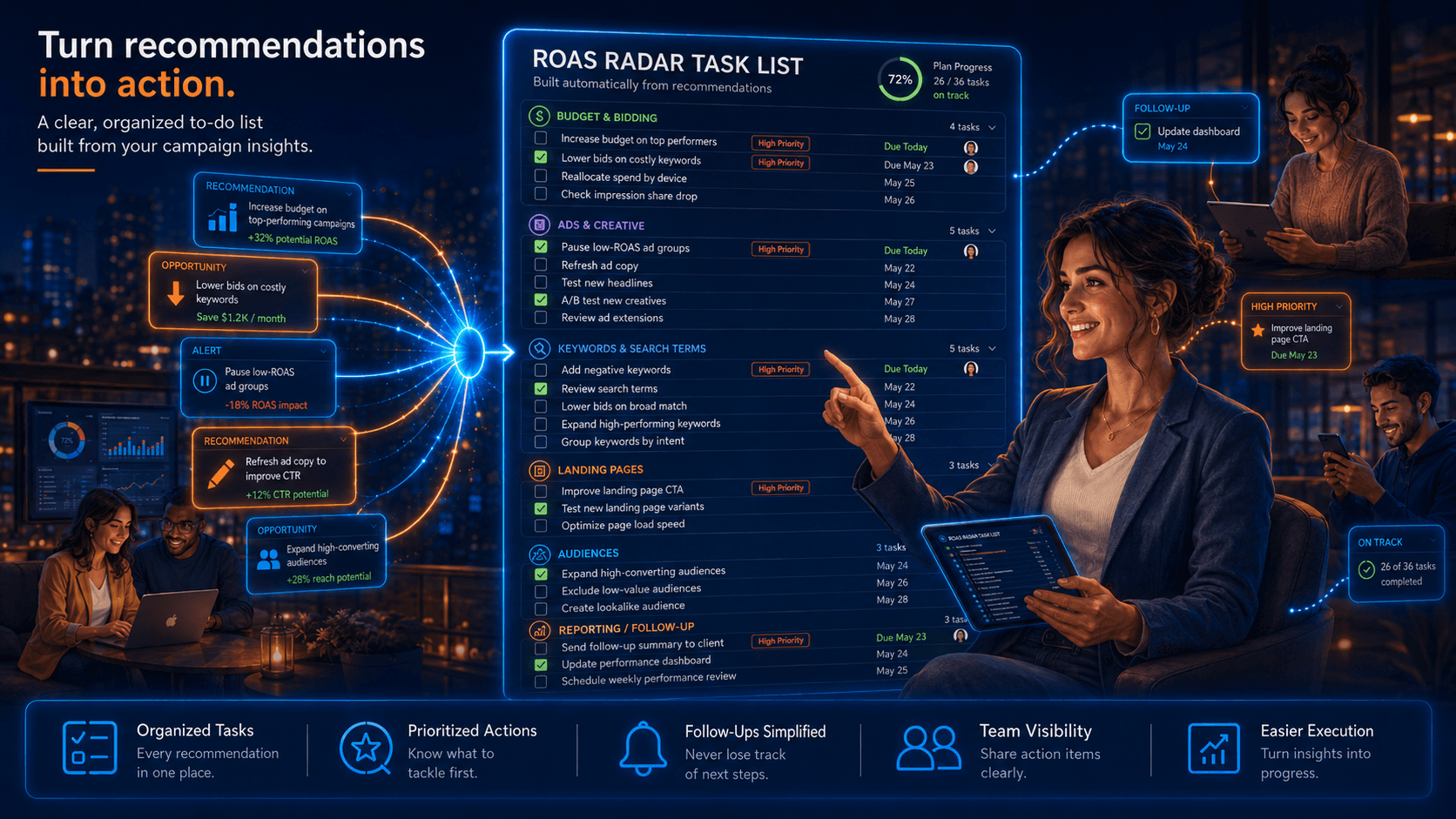
One good prompt can spawn a dozen action items. ROAS Radar now lets you save any recommendation to a to-do list — organized by category, priority, and brand or client — so nothing good gets lost.
There's a specific kind of overwhelm that only happens when a tool is actually good.
You ask the agent one honest question — "where is wasted spend hiding across these accounts?" — and it comes back with a real answer. Not a number, a plan. Pause these four search terms. Tighten this match type. Shift this budget. Test this ad variant. Investigate why this landing page is dragging. Each one is a genuinely good call, and you nod along, and then you ask the next question, and it gives you ten more.
By the third prompt you've got a screen full of legitimately useful recommendations and the dawning realization that you are going to remember roughly four of them. The rest scroll up and out of your life. The insight was free; acting on it turned out to be the hard part.
That's the gap we just closed.
Now, right from inside the agent's answer, you can save any individual recommendation — or just an interesting thread you want to chase later — to a to-do list. One tap on the line that matters. It doesn't interrupt the flow of the conversation. You keep asking questions, keep covering ground, and the good stuff you want to come back to gets quietly set aside instead of lost.
And it doesn't land in an undifferentiated pile, because a flat list of forty to-dos is its own kind of useless. Each saved item gets organized along the axes that actually map to how you work.
By category. "Budget reallocations" in one place. "Negative keyword adds" in another. "Landing page issues" somewhere else. When you finally sit down to execute, you're batching similar work instead of context-switching forty times.
By priority. The $4,000-a-month leak and the "might be worth testing someday" idea are not the same task, and now they don't pretend to be. The list sorts so the things that move the number sit at the top, and the nice-to-haves wait their turn.
By brand or client. This is the one that matters most if you're running more than one account. Everything you saved for Client A stays with Client A. When that account's review comes up, the action items are already gathered, already prioritized, already waiting — instead of scattered across a week of conversations you'd have to go re-read.
What this really does is let you change how you work with the agent. You no longer have to stop and act on every insight the moment it appears, which means you no longer have to choose between exploring an account thoroughly and actually retaining what you find. You can go wide — ask the big diagnostic questions, follow the interesting threads, let one answer lead to the next — and trust that anything worth doing is captured and sorted, ready for you to work through piece by piece on your own schedule.
For a freelancer juggling ten accounts, that's the difference between "I know there's money in here somewhere" and a ranked list of exactly what to do next, per client, by Monday. For an agency, it's a shared, organized backlog of agent-surfaced opportunities instead of insights that lived and died in one person's chat window.
The analysis was never really the bottleneck. The bottleneck was the quiet leak between a good recommendation appearing on screen and it actually getting done. ROAS Radar has always been fast at the first part. Now it helps you finish the second.